Druesberg
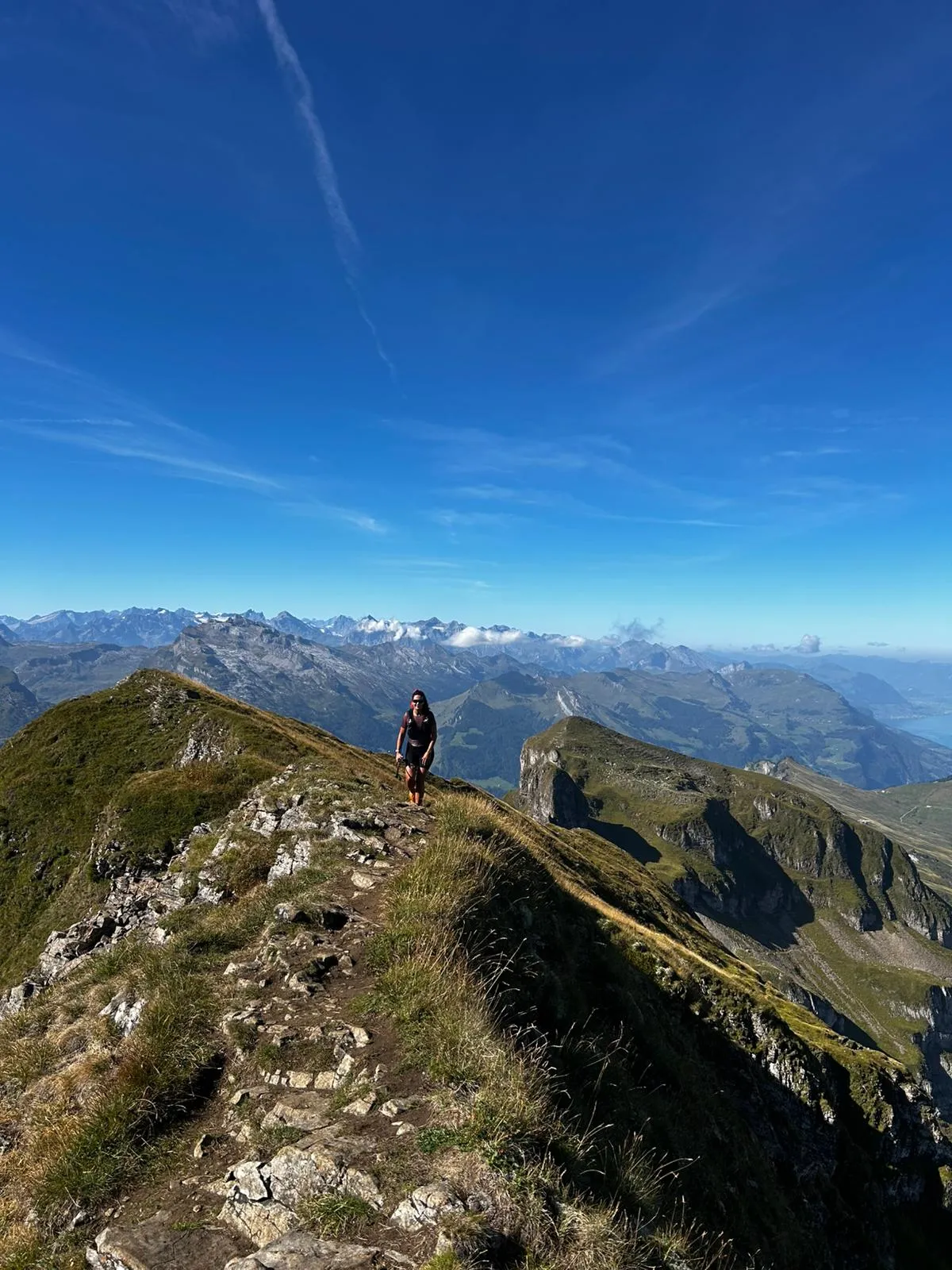
Whether you run it or walk it: the height gain is worth it! The airy ridge traverse to the Forstberg and some fine scrambling make this a treat of a tour.
The mountain that gave a nappe its name
The climb along the Weglosenbach is steep, and stays that way for a long time. Halfway up stands the Druesberghütte: you can refill your water here, the owners are exceptionally friendly, and if you have the time, a coffee before moving on is a fine idea. After that the pastures of the Chalberstöckli lead upwards, the last metres to the summit turn rocky and loose, but a wide panorama is waiting at the top.
Rather than returning the same way, the loop carries on west along the ridge to the Forstberg. The path traverses beneath rock walls, a few short climbing passages are secured with chains, and in between lies a trail of the kind you rarely find. “Flow trail” could have been coined right here — it is simply fun. After that the crest eases off over the Gross Stärnen, and the descent is lovely in its own right: under the Trittlipass to the Seeblisee, then over the Fuederegg through woods and meadows back to Weglosen.
The ridge looks out into the distance the whole way. Across the valley the two Mythen stand as sharp pyramids above the basin of Schwyz, with Lake Lucerne behind them. To the south the Urner Alps rise in ranks to the snow peaks, to the east the Glarus Alps — and on a clear day the Säntis stands right at the back.
The mountain gave its name to an entire geological nappe. The Drusberg nappe is one of the classic Helvetic nappes — a package of rock shoved kilometres northwards during the building of the Alps, and the loop stays inside it all day. You see it best in the strikingly folded rock, but also at the Seeblisee: the lake has no surface outlet, sitting instead in a closed karst hollow, and the water simply disappears downwards.
Tip: Start early. In the morning the steep climb lies in the mountain’s shadow, which is exactly where you want it. The four hours are a running time; if you walk the loop, better to plan for twice that.
How it went for me
Melissa and I set off early and took a short break at the Druesberghütte — not a bad idea on a climb this steep. We each carried only a trail-running vest with a light jacket, two gels and a litre of water, and that was entirely enough. Going up, the heart and lungs worked flat out; coming down, the legs made themselves heard. But the trail between the Druesberg and the Forstberg was one of the best we have ever run.